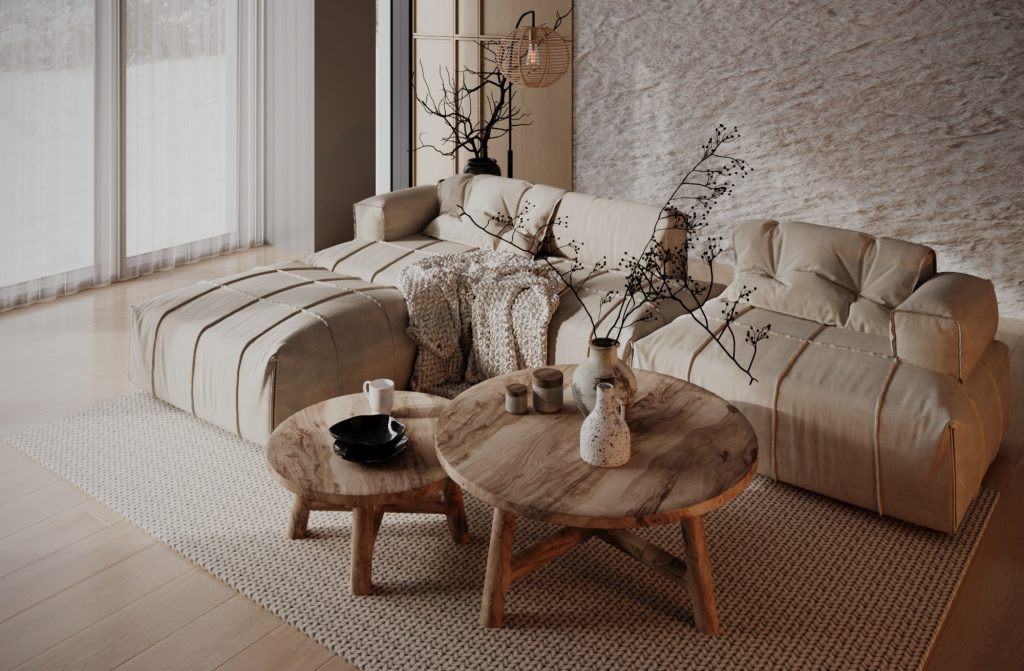
There are spaces that change our mood without us noticing. It’s not just about furniture or colors, but about how the space breathes around us. Sometimes, a simple corner with a large window can be more powerful than a wall full of paintings. Light enters, plays with shadows, reflections of furniture and textures, and suddenly the whole room seems to pulse in sync with our own breathing. Even a ray of sunlight hitting a corner of the room can subtly evoke a sense of harmony or tension.
The shapes of furniture and objects play an equally powerful role. Curved lines relax us, slow down our pace, and make us move more deliberately and feel more deeply. Straight lines and sharp angles put our mind on alert, stimulate concentration, and give a sense of order. Even choosing a chair or a table is not merely practical—their form can transform how we feel in that space.
Colors are never purely aesthetic; they communicate with our subconscious and can trigger unexpected emotions. Blue brings clarity and focus, while warm tones give us drive and energy.
The open air of a tidy room creates a feeling of inner freedom. Minimalism is not about rigidity or lack of character; it is about spaces that offer pauses for thought and moments of reflection. In an orderly room, free from visual clutter, our brain does not stumble over chaos and can breathe.
Interior space thus becomes a silent language. Every corner, every shade, every texture, and every object communicates with us. It influences our mood, our thinking, and even our creativity. Sometimes, without realizing it, a well-designed space can make us dream more, feel closer to ourselves, and enjoy life.